A Father, His Daughter, and the Real Definition of Integrity

Adam had known since his earliest memories that he was a storyteller. As a boy, children would gather around him to listen, and at social occasions, he was always the one regaling his friends with tales of his latest escapades—and more often than not, his comical mishaps. He loved sharing the wisdom of the sages through narratives, but lately, the topic he found himself sharing most with his own children was integrity: what it looks, smells, and sounds like in real life.
The Spark of Curiosity

This morning, after breakfast, a lively knock came at the door of his study. It was his 12-year-old daughter, Yasmine, absolutely filled with energy and buzzing with excitement.
"Dad! Dad! Dad! Can I ask you something?" she burst out.
Adam smiled warmly. "Of course, my dear daughter. You can ask me anything, go ahead. I always love it when you ask me questions."
"I was thinking about the stories you told us about integrity," Yasmine said, beaming. "I just love your stories, Dad!"
"And I love telling them to you and your siblings even more," Adam replied.
Yasmine looked her father right in the eyes, a big smile playing on her face. She knew exactly how much he appreciated it when she remembered key phrases or used thoughtful vocabulary. "In the last story, you said something that really intrigued me. You said that the very first step to learning about integrity and getting better at living it out is writing down what it means to us, along with the core values inside it. I think you called them our 'non-negotiables.'"
Adam was overcome with a massive, warm, and loving smile, bursting at the seams. He met her gaze with proud, affectionate eyes, and for a quiet moment, father and daughter shared a special, knowing connection.
The Forefront of Memory
"Yes, that is beautifully remembered, my daughter," Adam said. "The first step is indeed writing down those core values—what integrity means to us, what our non-negotiables are. For example, declaring, 'I stand for honesty.' But then it is equally important to define what we mean by that. We have to say, 'I will be honest with myself. I will learn what my strengths are and identify the areas where I need to improve.' And we do this by looking back on our day, every single day, recognising the moments where we did well and the moments where we fell short or found things difficult. That is how we plan to handle those situations better next time."
Yasmine nodded, her cheeky smile returning as she vibrated with energy and confidence. "Thank you, Dad. Now... can I ask a silly question?!"
Adam paused and gave his daughter a funny look, letting his eyes jokingly tell her that that question was a silly one.
Yasmine playfully cut him off. "Daaad! I am just pulling your leg! I know what you've told me probably since the first day I opened my eyes, before I even had my first sip of milk: 'My daughter, remember, there are no silly questions.'"
Adam laughed, filled with pride. "Well, I am glad you remembered. Though to be completely accurate, I actually started telling you that when you were still in your mum’s tummy... but that is a story for another time!"
Yasmine was instantly alive with curiosity. "Dad! Tell me, tell me, pleeeeease!"
"I promise I will come back to that story another time," Adam said with a reassuring smile. "First, let's make sure you finish the questions you brought for me today."
Realising she had gotten sidetracked, Yasmine focused her mind. "Right. Dad, I have two questions. First, we all already know what honesty is, so why do we actually need to take the time to write it down?"
Adam tilted his head. "That is a very good question. Before I give you my answer, let me ask you: what do you think the answer is?"
"Dad! Of course I don't know the answer, that's why I'm asking you!" she protested with a laugh.
"I know," Adam smiled gently. "But I asked what you think it might be, not what the answer is. Take a moment. Think about it and share your thoughts with me. I am genuinely interested in your perspective—hearing your thoughts is much more important to me right now than just handing you an answer."
The "Sometimes" Honesty Trap
Yasmine shifted into a reflective mood. She took a long pause, raking her mind, before finally speaking. "I think the answer might be that being honest has a lot of different angles. For one person, it might mean not cheating at school. For someone else, it means telling the truth, or admitting when they've made a mistake."
"I really like your thinking, Yasmine. It shows you are deeply analysing this," Adam said. "To help answer your question, let me pose another scenario to you. Because honesty has so many angles, can a person truly be called 'honest' if they never cheat at school and always admit their mistakes, but sometimes tell lies just to escape getting into trouble when they fail to do their homework?"
A quizzical look crossed Yasmine's face as she dropped into deep thought. "I guess the answer to that is yes and no. The person is being honest sometimes, and other times they aren't."
"So, in that situation," Adam pressed, "is that person actually 'honest'? Yes or no? And secondly, if they had written it down, what do you think their personal definition of honesty would be?"
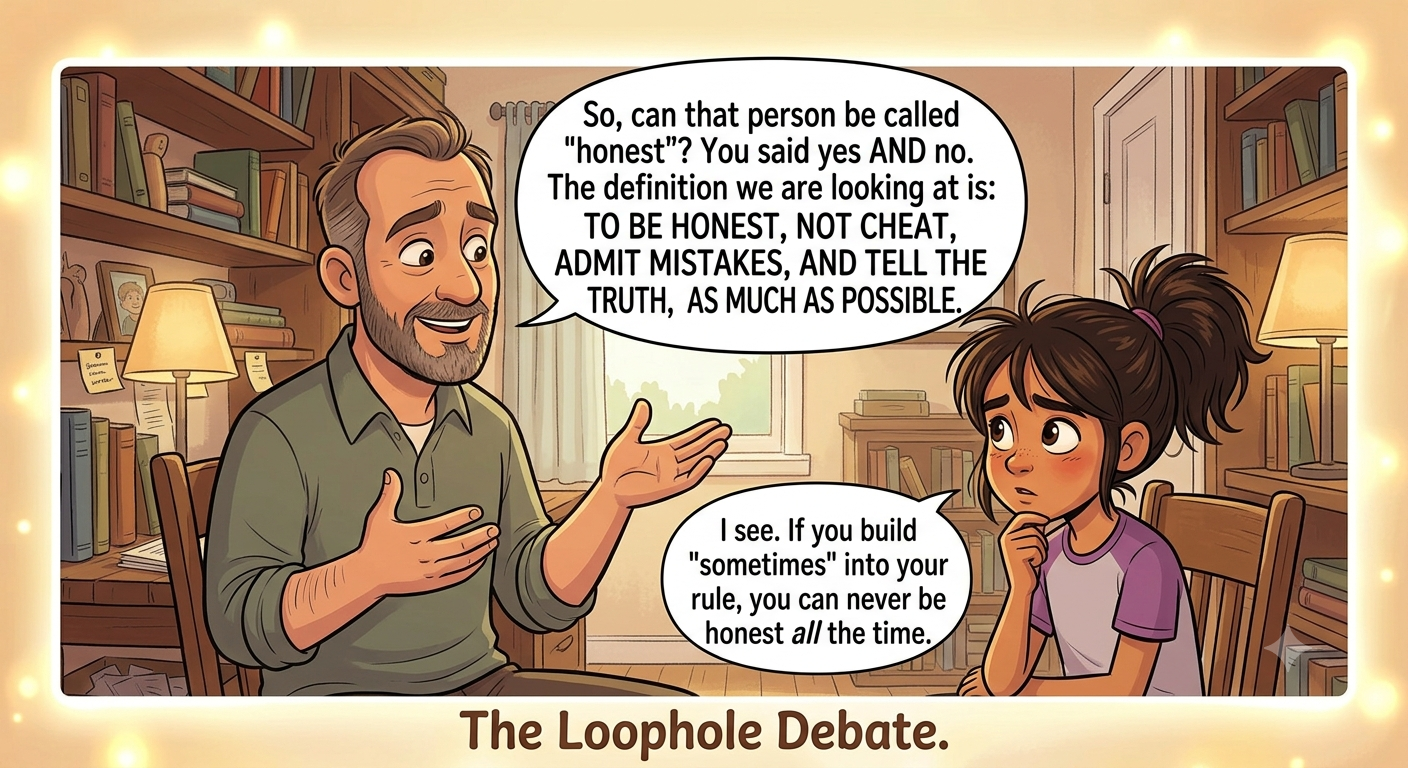
Yasmine paused, taking a deep breath. "I don't think it's a simple yes or no, because the person is honest most of the time, just not on a few occasions. And for the second part... I guess if they wrote it down, their definition would be: 'To be honest, not cheat, admit mistakes, and tell the truth as much as possible.'"
Adam smiled. "I love how you added that qualifier: 'as much as possible.' And notice how you answered the first question without a strict yes or no. But would you agree that for the question 'Is this person honest?', the real answer you gave is 'sometimes'?"
"Yeah, Dad. I see it now. The answer isn't yes or no, it's sometimes."
"Exactly," Adam said. "Now, why do you think the answer is 'sometimes'? Why can't they be honest all the time?"
Yasmine paused again, looking down. "I... I'm actually not sure, Dad."
"Think back to what you said their definition of being honest was," Adam guided her.
"Aah! I get it now, Dad!" Yasmine’s eyes lit up. "Because their definition was to tell the truth as much as possible, they built a loophole right into their rule! Because they set a goal to only be honest 'as much as possible,' they will always end up being sometimes honest."
"So, can that person truly call themselves an honest person? Yes or no? There are no 'sometimes' here."
"No," Yasmine said quietly. "They can't say they are honest. I guess they can only say they are sometimes honest."
"And that brings us to the core of it," Adam said. "If we are only sometimes honest, do we actually possess integrity? Yes or no?"
Yasmine thought for a moment. "Dad, I see. At school, my teacher taught us that integrity means doing the right thing even when no one is looking."
Adam smiled playfully. "Right. But for our fictional person here, their definition would actually be: 'doing the right thing even when no one is looking... sometimes!' Is that true integrity?"
Yasmine caught his smile and laughed. "That sounds so funny when you say it out loud, Dad. And no, that is definitely not integrity!"
"Perfect," Adam smiled. "Now, I recall you had a second question. What was it?"
"I understand now why it's so important to define what honesty means to me, and why I need to live it out all the time, not just when it's convenient," Yasmine said. "But my second question is simpler. Why do I need to physically write this down on paper or type it out on my laptop? If I’ve already taken the time to define it in my head, and I know what it is, what is the point of putting it on a piece of paper that I’ll probably just forget about over time?"
"Another excellent question, my daughter," Adam said. "And just like before, tell me what your instinct says first."
Yasmine shrugged, genuinely stumped. "Honestly, Dad, I have no idea. If I am already actively living out the value of integrity every single day, I just don't see what writing it down changes. It doesn't seem to add anything or take anything away."
Adam leaned back in his chair. "Who is the President of America?"
Yasmine looked perplexed by the random shift. "Donald Trump," she replied instantly.
"Does everyone in the USA know that? Do people around the world know that?"
"Yes, of course!" Yasmine said, laughing. "You’d have to be living under a rock not to know that!"
"If it is so obvious, and everyone already holds that information in their heads, why is it explicitly written down on every government website, official document, and record? Why isn't just spreading it via word-of-mouth enough?"
Yasmine thought about it. "It's not because people will forget... I think it's just a formality? To keep official records?"
The Exam Report Analogy
"Okay, let me give you a different example that hits closer to home," Adam said. "Imagine you sit a big exam at school. A few days later, your teacher comes up to you privately and gives you some incredible feedback. She tells you that you did amazing, and in fact, you got the highest grade in the entire class—an A*. A few more days pass, and the teacher publicly publishes the exam results. Everyone in class receives their official report sheet, except for you. How would you feel, and what would you say to your teacher?"
"I’d feel really upset!" Yasmine said adamantly. "I’d want my report too. I'd go up to her and ask, 'Where are my results?'"
"But imagine your teacher looks at you and says, 'Yasmine, you already know your results. You know you did exceptionally well and got the highest grade. Printing a physical piece of paper for you won't add to or take away anything from your achievement, so there's no need.' Would you be satisfied with that?"
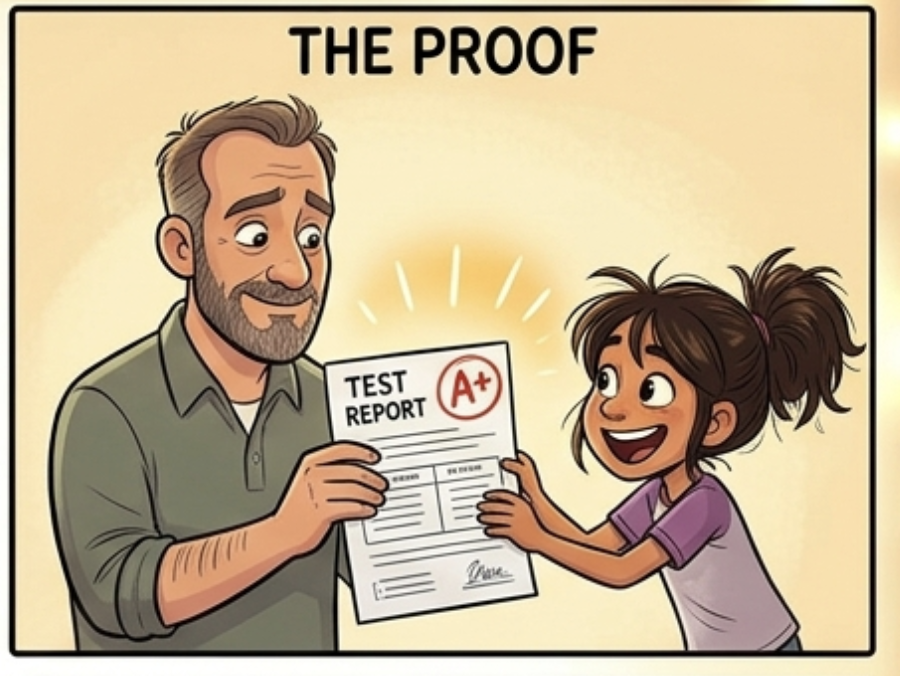
"No way!" Yasmine said, her voice rising with conviction. "I want to see my results in black and white! If everyone else got a physical printout, why shouldn't I? I need the proof!"
"Does that mean you don't trust your teacher's words?" Adam asked with a raised eyebrow.
"No, Dad, it's not about trust," she said, trying to find the words.
"But like you said, a piece of paper won't change the grade itself," Adam pushed gently. "In fact, your teacher even stands up and tells the whole class, so all the students and all the other teachers know you came top of the class. You have all the verbal validation you could want."
"Dad... I don't care," Yasmine insisted. "I still want to see my exam results written down."
"But ask yourself, why?"
Yasmine paused, looking inward. "Because... it makes it real. It's proof. Seeing it with my own eyes gives me a feeling of reassurance."
Adam’s smile widened. "Do you see now why writing down your how, your what, and your why for integrity is so important?"
Yasmine stared at him, a realisation dawning on her, though she still wanted clarity. "Dad... I can see a link, but they still feel like different things to me. Please spell it out for me!"
Adam leaned forward, his tone shifting into that of the comforting, guiding storyteller she loved.
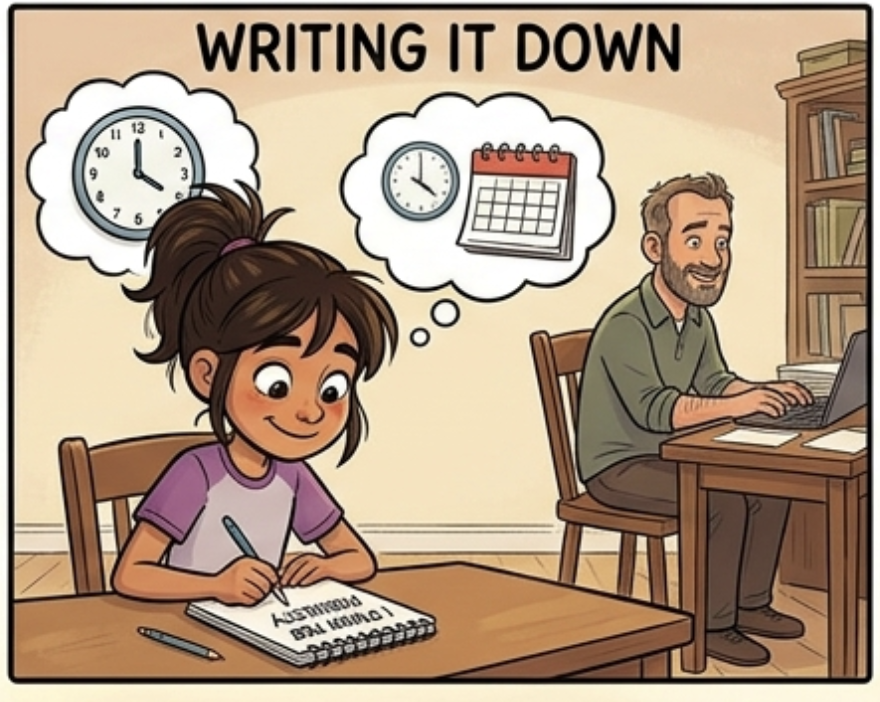
"Writing things down is vital for two distinct reasons, Yasmine. First, putting it on paper or typing it onto your laptop pulls it out of the abstract. It makes it real—it is no longer just a floating thought in your imagination. And to make sure that reality stays strong, you treat it like an advertisement or a poster. You place that writing in a convenient spot where you will naturally see it every day, whether that's physically on your desk or digitally on your device. You look at it, review it, and remind yourself of it regularly. Repetition is everything. Human beings remember things infinitely better when they are anchored by a constant visual cue.
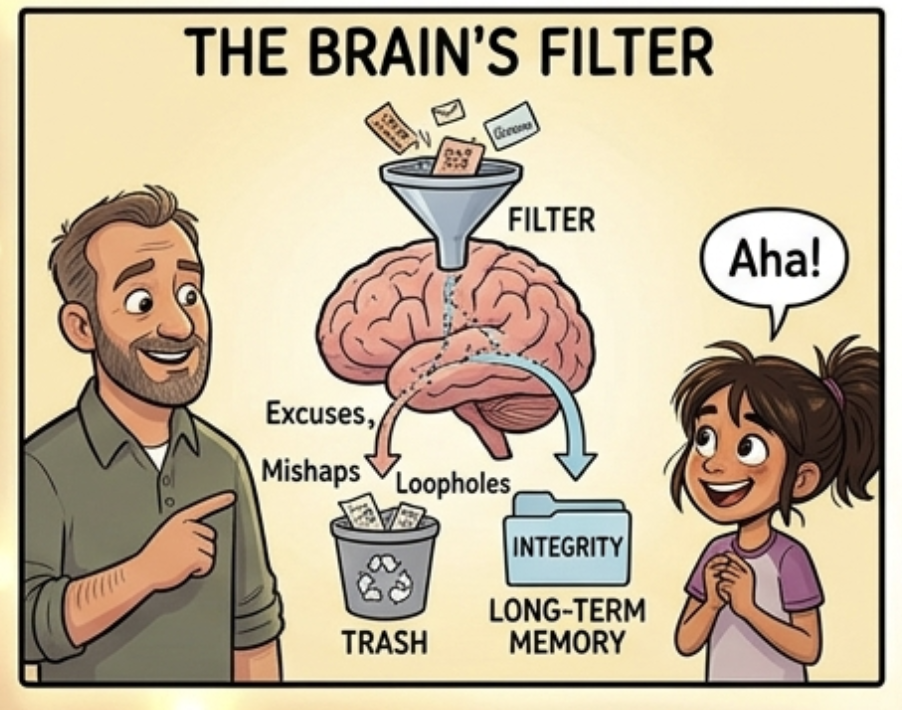
Secondly, it’s about how our biology works. Our brains process an overwhelming amount of information every single second. To keep us from going crazy, the brain operates a subconscious filtering system, constantly deciding what details to delete and what to save into our long-term memory. The physical act of writing something down acts as a heavy neurological flag. It signals to your brain: 'Pay attention, this specific information is important, retain it.' When you combine that initial writing flag with the daily visual reminder, you drastically increase the chances of that value sticking in your mind. It transforms from a vague concept into a tangible foundation that dictates how you actually act. Does that make sense?"
A beautiful, bright smile lit up Yasmine’s face, her eyes sparkling with understanding.
"I completely get it now, Dad. If I write down my definition of integrity and put it in my diary, or make it the screensaver on my laptop where I'm forced to see it every day, I am way more likely to actually remember it when it matters—and then actually apply it."
Dad smiled back, his heart swelling with a deep, profound pride.
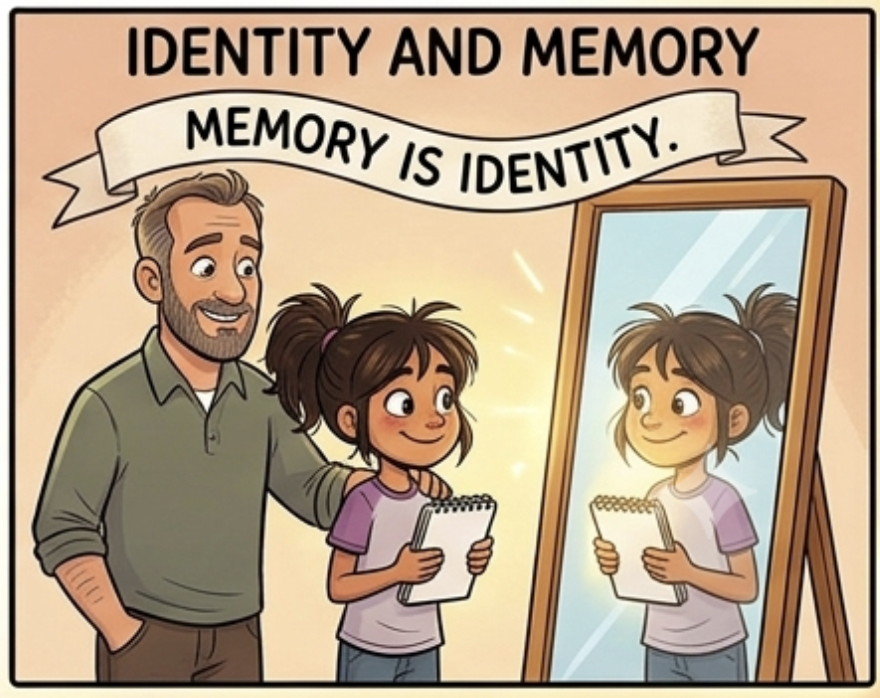
"Yes, that is beautifully and perfectly put, my daughter," Adam said, meeting her eyes. "Never forget that what we choose to keep in front of our memory shapes who we become. As the writer Julian Barnes once said, “Memory is identity... You are what you have done; what you have done is in your memory; what you remember defines who you are.” Write your values down, Yasmine, protect them, and you will always remember exactly who you are."